Buying a physio table feels straightforward until you are standing in your clinic on day one and realise the table you ordered does not quite work the way you expected. The height is fixed at a level your therapist finds uncomfortable. The padding feels firm enough in a showroom, but starts showing wear within months. The sections do not adjust the way your treatment protocols actually need them to.
It happens more often than people admit. And the table stays in your clinic for years, so getting this wrong is not a small thing. Here is what actually matters when you are making this decision.
Start With How Your Therapists Work
The physio table is a tool for your therapist, not just a surface for your patient. Before you look at specifications, spend a few minutes thinking about what your therapists do all day.
Do they work standing at one height throughout a session, or do they adjust their posture depending on the technique? Do they treat patients with mobility limitations who need a low-access height to get on and off the table without help? Do they perform traction, mobilisation, or Bobath-based techniques that require specific table configurations?
Fixed Height vs Hi-Lo: Where Most Clinics Get This Wrong
A fixed-height physio table costs less upfront. That is its main argument. It works fine if all your therapists are roughly the same height and your patient population is fairly uniform. In most real clinics, neither of those things is true.
A height-adjustable table, particularly an electrically operated Hi-Lo table, lets each therapist set the working height to their own ergonomic preference. That matters for musculoskeletal health over a long career. The Indian Physiotherapy Association has flagged work-related musculoskeletal disorders among physiotherapists as a documented occupational concern, with poor workstation ergonomics listed among the contributing factors.
Beyond therapist comfort, a low-access height setting makes patient transfers safer. Older patients, post-surgical patients, and patients with limited mobility can get onto a low table with far less risk than climbing onto a fixed-height one. That is a patient safety consideration, not just a convenience.
How Many Sections Do You Actually Need
Most physio tables come in two-section or three-section configurations. Some specialist tables go further.
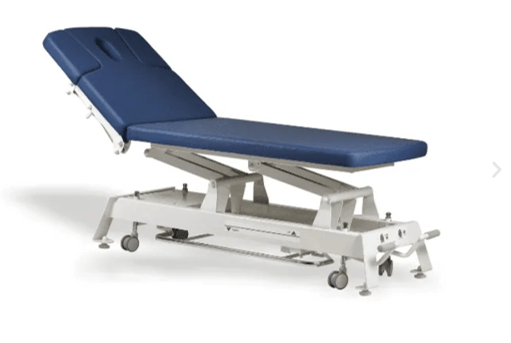
The Parth Physiotherapy Table from Esthetica Medical Furniture is built around this kind of multi-section adjustability, with a walk-free switch feature that lets the therapist reposition sections without stepping away from the patient. That detail sounds minor. It is not. Breaking contact with a patient during manual therapy to reach a control lever is a workflow interruption that adds up during a full day of sessions.
Think about your most common treatment protocols. If your practice works heavily with neurological rehabilitation, a Bobath table with specific drop sections is a different requirement again. Do not buy a general-purpose table if your work is specialised.
Upholstery and Load Capacity
There is a tendency to treat upholstery as an aesthetic choice. It is not.
Physiotherapy involves lotion, oil, heat packs, and repeated disinfection. Upholstery that cannot handle frequent cleaning with standard clinical disinfectants will crack and peel within a year or two. Once the surface breaks down, the table becomes an infection control problem. That is a harder conversation to have with a patient or an inspector than simply buying the right specification from the start.
Check that the upholstery carries UV-resistance and disinfectant-resistance ratings. Foam density matters too. Low-density foam compresses over time and loses its support, which affects patient comfort and potentially treatment outcomes in rehabilitation work where positioning is precise.
Load capacity is perhaps the most skipped specification. Most standard tables are rated to around 150 to 180 kg. If your patient population includes bariatric patients or athletes with high body weight, that margin may be narrower than you realise. A table operating near its rated capacity feels different from one well within it. Patients notice. So do therapists.
Frame Construction and What It Tells You
A powder-coated steel frame with precision welding holds up in a clinical environment. It resists corrosion from the cleaning chemicals used in daily disinfection routines. It does not flex or creak under load.
Frames built from lighter materials or with visible joining shortcuts may look identical in a photograph. They perform differently over three to five years of daily use. Ask about the frame specification before you buy. A manufacturer with in-house fabrication capability should be able to answer that question directly.
See also: The Difference Between Managing Pain at Home and Seeing the Best Orthopedic Doctor in Ranchi
What the Right Table Feels Like in Practice
When the table fits your practice, you stop noticing it. Your therapists set their height, work through their sessions, and the table just does what it is supposed to do. Patients transfer safely. Sections hold their position. Disinfection takes a minute.
When the table does not fit, you notice it every day. And so does your team.
That is the decision worth getting right before the order is placed, not after.